Acumatica vs QuickBooks: Which Fits Your Firm?

Many construction and engineering firms start with QuickBooks, and for a while, it works.
It’s simple, familiar, and handles day-to-day accounting. But as projects multiply and financial complexity grows, spreadsheets, manual reconciliations, and limited visibility start to slow everything down.
That’s when firms begin looking for something more robust.
Acumatica is a true cloud ERP (Enterprise Resource Planning) system designed to manage not just transactions, but the entire business, including finance, projects, and operations, all in one connected platform.
This guide compares Acumatica vs QuickBooks to help project-based firms decide which system best fits their growth.
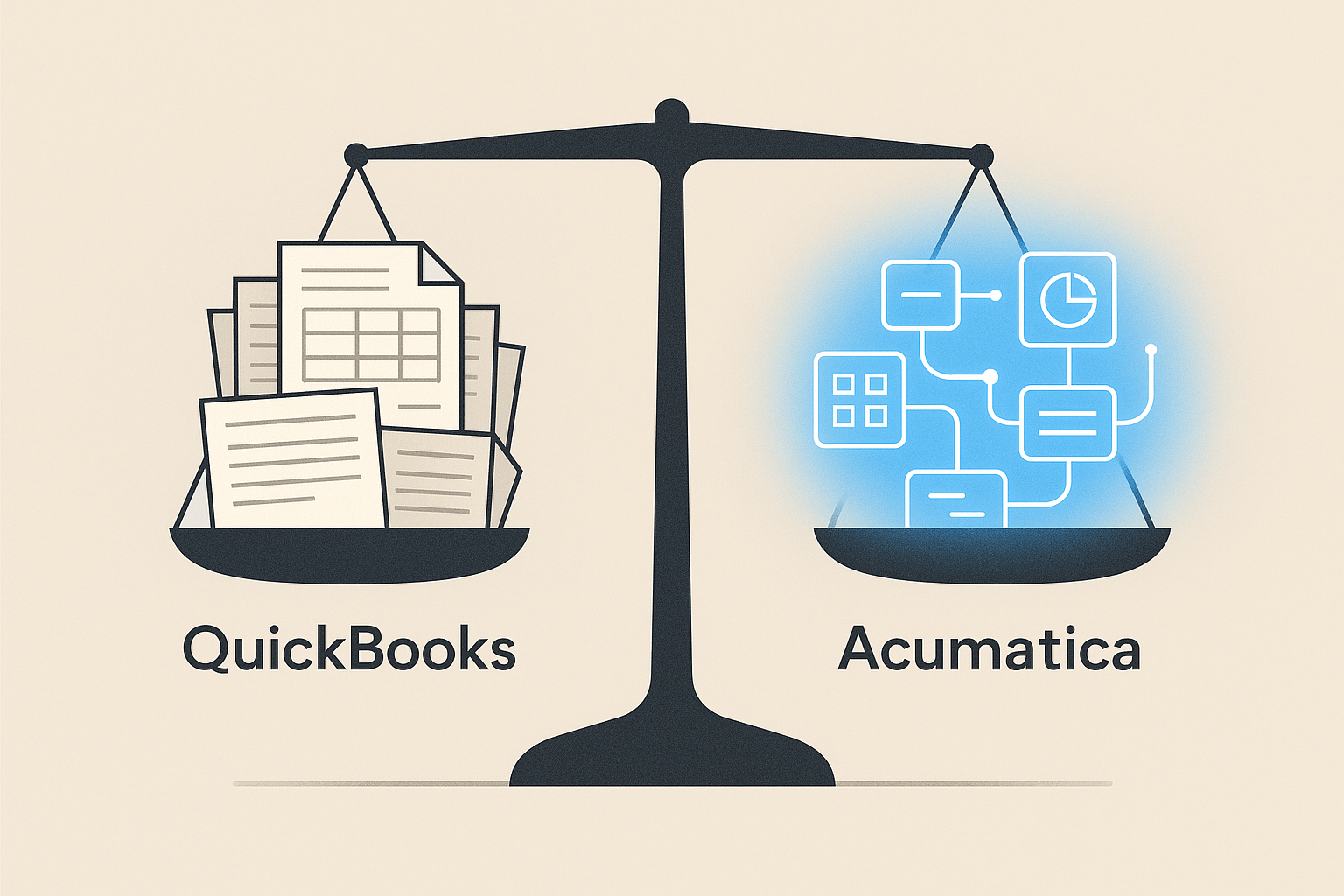
QuickBooks vs Acumatica—What’s the Core Difference?
At the core, the difference comes down to scope. QuickBooks is accounting software, and it’s designed to record transactions, manage invoices, and keep your books balanced. It does that job well, but it stops there.
Acumatica, on the other hand, is a full Enterprise Resource Planning (ERP) system. It goes beyond accounting to connect your entire business: finance, projects, operations, and reporting. Instead of managing transactions, it manages your entire workflow, from field updates to executive dashboards, all in one platform.
In plain terms, QuickBooks helps you count the numbers while Acumatica helps you understand them.
While QuickBooks is great for small businesses, Acumatica is built for growing construction and engineering firms that need to see the big picture. It scales with your operations, supports unlimited users, and delivers real-time project visibility across departments.
Here’s how they differ in key areas:
- System Type: QuickBooks is accounting software; Acumatica is a full ERP that integrates accounting, operations, and project management.
- Scalability: Acumatica supports unlimited users and grows with your firm. QuickBooks often slows down as data and users increase.
- Project Management: Acumatica includes built-in job costing, forecasting, and billing, while QuickBooks offers only basic project tracking with limited visibility.
- Reporting: Acumatica delivers real-time dashboards and KPIs; QuickBooks relies on preset reports that don’t update live.
- Integrations: Acumatica connects natively with CRM, document management, and field service tools. QuickBooks depends on third-party plug-ins that can create data silos.
- Pricing Model: Acumatica charges based on resources used, not users. QuickBooks uses per-user pricing and add-ons that raise long-term costs.
- Industry Fit: Acumatica offers editions tailored for construction and engineering. QuickBooks fits smaller firms with basic bookkeeping needs.
Ultimately, QuickBooks provides a solid start, but Acumatica delivers the visibility and control project-based firms need to grow confidently.
Why Firms Outgrow QuickBooks
Most project-based firms reach a point where QuickBooks can’t keep up.
Common pain points include:
- Manual consolidations between companies and projects.
- Limited project-level reporting or WIP visibility.
- Lack of real-time dashboards for executives and project managers.
- Security and user-access limitations.
Firms that operate multiple entities or manage complex contracts often find themselves exporting data into spreadsheets just to see profitability, and that manual work eats into margins and makes forecasting nearly impossible.
What Acumatica Does Differently
Acumatica is a cloud ERP that provides one connected system across all departments. It eliminates silos by linking financials, projects, and operations in real time.
Key capabilities include:
- Job Costing: Track actual vs. budgeted costs by phase, task, or resource.
- Project Forecasting: See margin impact before it happens.
- Multi-Entity Management: Consolidate financials and projects across companies.
- Automated Workflows: Streamline purchase orders, approvals, and pay apps.
- Custom Dashboards: Visualize KPIs across roles, from CFO to field manager.
Because Acumatica offers unlimited users, your entire team can access the same system without extra licenses.
And with industry-specific editions like Acumatica Construction Edition and Acumatica Professional Services Edition, firms get tools tailored to their workflows, not generic software they need to customize from scratch.

Comparing Features
Scalability
Acumatica: Built to grow with your business, so you can add users and functionality without limits.
QuickBooks: Designed for small teams, so performance and storage may decline as your projects expand.
Project Management
Acumatica: Includes robust project accounting like job costing, change order tracking, and milestone billing.
QuickBooks: Basic project tracking only. Complex needs require multiple add-ons.
Reporting and Visibility
Acumatica: Live dashboards and customizable reports give leaders real-time visibility into project profitability.
QuickBooks: Limited to preset reports; data is static and often outdated by the time it’s shared.
Integration and Customization
Acumatica: Natively integrates with CRM, document management, and field tools. Customizable workflows fit how your firm already operates.
QuickBooks: Relies on third-party integrations, increasing the risk of data silos or sync errors.
Cost Model
Acumatica: Resource-based pricing meaning that firms pay for what they use, not how many people log in.
QuickBooks: Lower upfront cost, but add-ons, upgrades, and user limits raise total costs over time.
Industry Fit
Acumatica: Purpose-built for construction and engineering firms with role-based dashboards, job cost tracking, and forecasting.
QuickBooks: Suited for small businesses managing basic bookkeeping, not complex project workflows.
In short, QuickBooks might seem cheaper upfront, but Acumatica delivers far more value and control as your firm grows.
Which Is Better for Construction and Engineering Firms?
For project-based firms, visibility and control are everything.
Acumatica Construction Edition streamlines job costing, milestone billing, and subcontractor payments all from one platform. Acumatica Professional Services Edition supports time and expense tracking, resource forecasting, and WIP reporting.
Firms that implement Acumatica often report:
- Faster monthly closes
- Fewer billing errors
- Real-time profitability tracking
- More confident forecasting
And with ReviveERP, these capabilities go even further. We tailor dashboards, workflows, and approval chains around how construction and engineering firms actually operate, so that project managers, accountants, and executives are always looking at the same numbers.
Cost and ROI Comparison
Yes, QuickBooks is less expensive at the start. But when firms factor in add-ons, manual data cleanup, and integration costs, the total cost of ownership quickly rises.
Acumatica’s ROI comes from:
- Unlimited users—no extra license costs
- Cloud access from any device
- Automated reporting and approvals that save hours every week
- Eliminating duplicate data entry and reconciliation
Our clients typically see major time savings within months, especially in financial close and reporting cycles.
How to Choose Between Acumatica and QuickBooks
Before deciding, ask your team:
- Are we managing multiple entities or divisions?
- Do we need real-time project profitability insights?
- Are we spending hours on manual reporting?
- Are we hitting QuickBooks user or performance limits?
If you answered yes to any of these, it might be time to upgrade from QuickBooks to Acumatica. See how Acumatica performs in your industry—book a demo.
Why Work with ReviveERP
At ReviveERP, Acumatica isn’t one of many systems we implement, it’s the only one.
Our team specializes in Acumatica for construction and consulting engineering firms, and we configure every workflow, dashboard, and report to fit your exact operations.
Why firms choose ReviveERP:
- Exclusive focus on Acumatica with no divided attention across other ERPs.
- Deep industry expertise in job costing, billing, and multi-entity reporting.
- Proven success helping firms modernize their systems and improve visibility.
If your firm has outgrown QuickBooks, we can help you take the next step. Talk to an Acumatica specialist who knows your industry.
Related Resources


Safety Management Group now thrives using Acumatica ERP.